





Determinants of quality of life among older adults with recurrent diabetic foot ulcers


Introduction: Diabetic foot ulcers (DFUs) are a serious
complication of diabetes mellitus. DFUs have a profound
impact on patients’ health-related quality of life (HRQoL).
This study aimed to evaluate age-related variations in
HRQoL and to identify factors associated with physical and
mental health among patients with recurrent DFUs.
Materials and Methods: A cross-sectional study was
conducted among 245 patients with type 2 diabetes mellitus.
HRQoL was measured using the Indonesian version of the
SF-36, whereas depression, diabetes distress, and self-care
adherence were evaluated using the Beck Depression
Inventory II (BDI-II), the Diabetes Distress Scale-17 (DDS-17),
and the Summary of Diabetes Self-Care Activities (SDSCA),
respectively. Data were analysed using bivariate tests and
multivariate linear regression.
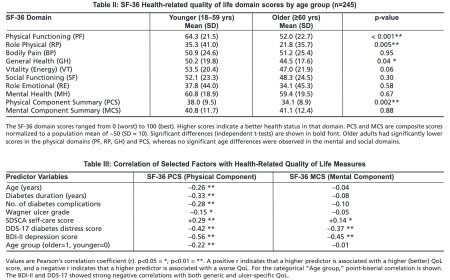
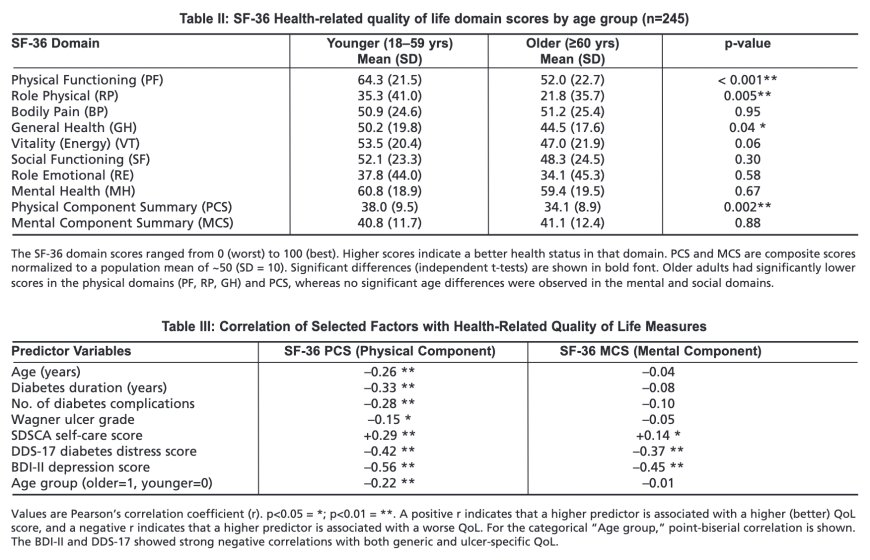
Results: Older adults (≥60 years) had significantly lower
physical functioning and general health scores (p < 0.05).
Depression (β = –0.48, p < 0.001) and diabetes distress (β =
–0.25, p = 0.003) were independent predictors of poorer
physical HRQoL, whereas higher self-care adherence
improved HRQoL (β = 0.18, p = 0.014). Age was not a
significant factor after adjustment. Physical HRQoL is
poorer among older adults with recurrent DFUs, primarily
mediated by psychosocial distress.
Conclusion: Our findings demonstrated that psychosocial
conditions, especially depression and diabetes-related
distress, significantly contribute to poor HRQoL. There is a
relationship between depression, distress, and poor quality
of life. Moreover, depression and distress independently
predicted lower physical QoL, and better self-care is a
predictor of QoL. Integrated management addressing
psychological well-being and self-care behaviours may
enhance the overall patient outcomes. https://www.e-mjm.org/
What's Your Reaction?
 Like
0
 Dislike
0
 Love
0
 Funny
0
 Angry
0
 Sad
0
 Wow
0